Count Rostov was Right. The Lab is Everything That Has Gone on in the Lab

I have spent my commute for the last month listening to A Gentleman in Moscow by Amor Towles. It is a long novel recommended by Barb, detailing the life of Count Rostov, a Russian nobleman, sentenced to house arrest in Moscow’s Metropole Hotel after the Russian Revolution. So far, I’ve covered about 40 years of his life, and I still have 4 more CDs to go. As I said, it is a loooong novel, but a fascinating and very quotable piece of literature.

At one point, the Count reflects on the Piazza, one of the hotel’s restaurants. In a discussion with a young artist sketching the scene, the Count proposes that while the room itself may be nothing special to look at, what is special about the room is “all the things that have gone on in it.”

So it is with the lab. Yes, it’s a hodgepodge result of multiple expansions and remodels, with wandering hallways and blind intersections. But for the last 17 years, it has been filled with people, experiences, joys, and sorrows.

The lab has been filled with the sound of some 50 employees (who thankfully didn’t work at the same time,) five different pathologists (who thankfully agreed with each other most of the time,) and at least one visiting cat.

The lab has been filled with the exuberance and fun of Lab Week–I still have flashbacks to being hit in the face with a pie as part of a fund-raiser, and the silence of Covid–as we went about our business masked and distanced from each other.

The lab has been the site of committee meetings, board meetings, and a national uropathologist session. The lab has been inspected, specimens have been dissected, and unlabeled cups of urine have been rejected. We have been doused in formalin perfume and withered at the petri dish of odors emanating from our microbiology lab.

The lab has been our setting as pathology has changed in the last 17 years. In our journals, photomicrographs of interesting tumors have been supplanted by details of their genetic sequence. The value of PSA screening has been challenged (I say keep on screening) and recently the idea of reclassifying some prostate cancers as benign has been floated (I say sink the idea.)

Sadly, the lab has seen us mourn, not once but twice — firstly over the loss of a tech who was taken from us by leukemia in the short span of a month, and secondly for a cytologist who valiantly fought an unremitting high-grade brain tumor over the course of over a year.

Returning to Count Rostov–as my career is racing towards its end I see how right he was! It’s not the floors or walls or instruments that make our lab memorable. It isn’t the technology. As the count said, our lab is made of all the things that have gone on within it.

And there are just a few more months for me to take it all in.


The views are those of the author and not Uropartners LLC.


Like what you read here? Add your name to our subscription list below. No spam, I promise! ___

#mc_embed_signup{background:#fff; clear:left; font:14px Helvetica,Arial,sans-serif; }
/* Add your own MailChimp form style overrides in your site stylesheet or in this style block.
We recommend moving this block and the preceding CSS link to the HEAD of your HTML file. */

Subscribe to our mailing list

* indicates required
Email Address *
First Name
Last Name
//s3.amazonaws.com/downloads.mailchimp.com/js/mc-validate.js(function($) {window.fnames = new Array(); window.ftypes = new Array();fnames[0]=’EMAIL’;ftypes[0]=’email’;fnames[1]=’FNAME’;ftypes[1]=’text’;fnames[2]=’LNAME’;ftypes[2]=’text’;}(jQuery));var $mcj = jQuery.noConflict(true); ———————————–

A Prostate Pathologist Pencil Pusher. Making a Better Diagnosis.

Tools of the trade.

Using a pencil in the laboratory? Absolutely verboten. If you write down something in the lab, make sure it’s in indelible ink, magic marker, or perhaps blood. Something, anything, that can’t be erased.

Does a tech need to make a change in what they see on an instrument printout? Our accreditation regulations (courtesy of the College of American Pathologists) are pretty strict:

  • Original (erroneous) entries must be visible (ie, erasures and correction fluid or tape are unacceptable) or accessible (eg, audit trail for electronic records).
  • Corrected data, including the identity of the person changing the record and when the record was changed, must be accessible to audit.

In layman’s terms, that means carefully drawing a line through your mistake, initialing, and then dating your correction.

So what am I doing wearing pencil after pencil down to its nub? I am making sure I am the best pathologist I can be.

Through this part of my career, looking at multitudes of prostate biopsies, I have developed, inaugurated, and continuously improved a printed, unofficial worksheet that I use for every prostate case. At the top of each sheet our laboratory information system prints the patient’s name, age, medical record number, and pathology case number. I then search the medical record and add in relevant clinical history, such as previous biopsy findings, PSA values, and results from imaging studies.

The sheet then contains a row for every biopsy location. After looking at each slide I can quickly pencil in whether I think the biopsy is benign or malignant, what the Gleason Grade is, the extent of tumor, and any special studies I want to perform. It is really a very efficient way for me to work.

And I do it in pencil. Why? Because diagnostic pathology is not all ink–it is an art as well as a science. Cancer cells don’t actually have a big “C” on them under the microscope. Malignant changes can be striking, but they can also be subtle, and first impressions can sometimes be misleading.

Sometimes looking at the 7th core in a patient’s biopsy series can affect how I view what I saw on the 3rd biopsy. Sometimes special stains are going to nudge me to call a biopsy malignant that I had originally noodled in as “atypical.” Sometimes viewing a core the next morning will clarify my thinking, or a word from my associates will lead me in a better direction. When any of those things happen I grab my worksheet and out comes my pencil, eraser end first. And I mark down my new, improved, diagnosis.

Eventually, the worksheets get turned into our administrative team, entered into a digital pathology report, and following my electronic signature, become very official. Corrections can still be made, but only through a very regimented procedure, with documentation of every step. No more pencils, no more erasers.

But rest assured, the next morning I will be at the sharpener, getting my favorite diagnostic tool ready for another busy day.


Like what you read here? Add your name to our subscription list below. No spam, I promise! ___

#mc_embed_signup{background:#fff; clear:left; font:14px Helvetica,Arial,sans-serif; }
/* Add your own MailChimp form style overrides in your site stylesheet or in this style block.
We recommend moving this block and the preceding CSS link to the HEAD of your HTML file. */

Subscribe to our mailing list

* indicates required
Email Address *
First Name
Last Name
//s3.amazonaws.com/downloads.mailchimp.com/js/mc-validate.js(function($) {window.fnames = new Array(); window.ftypes = new Array();fnames[0]=’EMAIL’;ftypes[0]=’email’;fnames[1]=’FNAME’;ftypes[1]=’text’;fnames[2]=’LNAME’;ftypes[2]=’text’;}(jQuery));var $mcj = jQuery.noConflict(true); ———————————–

Every Paper Clip Is Another Life Changed

Each clip=one prostate cancer case.

A small cylindrical plastic container sits on the desk behind me. I am not sure what it originally contained but now it is filled with paper clips. A quick glance tells me it must have a couple of hundred clips inside it, and every day I add a few more. I empty the receptacle a few times a year, but in the meantime, each clip tells me that someone’s life has been changed.

How is that so?

Medicine is more and more digital these days. You complain to your friends about how your internist spends more time typing into their laptop than they do talking to you. Your prescriptions go out to the pharmacy electronically, and reminders about your next appointment zip to your cellphone, instead of coming on a little postcard in the mail.

Here in the lab, we are digital too…but we still use a lot of paper. While most of the blood tests we do are managed without anything written down (each analyzer “talks” directly to the interface that sends results to our docs), we handle our biopsies quite differently.

Our Laboratory Information System (fancy name for lab computer) contains all the necessary information about patient age, and gender, and the site from which a bladder or prostate biopsy has been taken. But when I am looking at cases from 15 or 20 different patients, it really helps to have this data printed out. Also, I like to create paper worksheets for my prostate cases on which I can mark my findings for each of the dozen or so cores from each patient.

When my final diagnosis for the case is benign prostate, I can enter my findings from the worksheet directly into the LIS myself with a few keystrokes, and then add my electronic signature. No extra trees need to be cut for those cases.

But for patients in whom I find cancer, I turn my completed worksheet over to our administrative team. They keyboard the complex findings into the LIS and then print a copy of exactly how my report will appear to the clinicians.

When those printed cancer case reports come back to me, I review the information, correct the rare typos, have one of my colleagues concur on the malignant diagnosis, and affix my electronic signature in the LIS. The report can fly off to one of our urologists through an electronic labyrinth.

But because I need to select the appropriate charge to the patient for the laboratory and pathologist services, the reports are paper clipped to a billing slip. When I separate the report from the billing slip I toss the paper clip into the little container behind me. The container fills, each added clip representing another person given the diagnosis they were dreading and hoping to avoid.

Making those diagnoses is a pretty awesome burden and at times a humbling experience. I just hope that I can be as consistent as a bucket-full of paper clips; doing my job, holding it together, and remembering that there are people whose lives may be altered by every one of those diagnoses. They all deserve the best that I can be.


The above is the opinion of the author and not UroPartners LLC.


Like what you read here? Add your name to our subscription list below. No spam, I promise! ___

#mc_embed_signup{background:#fff; clear:left; font:14px Helvetica,Arial,sans-serif; }
/* Add your own MailChimp form style overrides in your site stylesheet or in this style block.
We recommend moving this block and the preceding CSS link to the HEAD of your HTML file. */

Subscribe to our mailing list

* indicates required
Email Address *
First Name
Last Name
//s3.amazonaws.com/downloads.mailchimp.com/js/mc-validate.js(function($) {window.fnames = new Array(); window.ftypes = new Array();fnames[0]=’EMAIL’;ftypes[0]=’email’;fnames[1]=’FNAME’;ftypes[1]=’text’;fnames[2]=’LNAME’;ftypes[2]=’text’;}(jQuery));var $mcj = jQuery.noConflict(true); ———————————–

“Friends” Don’t Let Friends Skip Their Prostate-Specific Antigen (PSA) Test

There has been plenty of talk about the reunion of the Friends cast earlier this month. Maybe you were a fan of the show during its original run and wanted to see how the actors had aged, or maybe you discovered it online and wanted to see something new. In any case, it was good to see your friends hale and hearty.

But then news broke this week that James Michael Tyler has advanced (Stage 4) prostate cancer. You may remember that Mr. Tyler played Gunther, the Central Perk manager who appeared in more episodes of Friends than anyone other than the Big Six. Call him The Magnificent Seventh.

So as I do anytime the chance arises, I remind you, or your partner, or your father, brother, uncle, our second-cousin-twice-removed to please get screened for prostate cancer (PCa). PCa is by far the most common cancer diagnosed in men in the USA, and the second leading cause of male cancer death.

The Prostate Specific Antigen blood test is still the most common test used in prostate cancer screening. It isn’t perfect, there are false positives and false negatives, but it is inexpensive, readily available, and when used intelligently to guide the patient-physician relationship it is useful in alerting to the possibility of prostate cancer. And there are lots of other associated lab tests such as Free PSA and Prostate Health Index (PHI) that can help make blood testing more specific.

Suppose you and your doctor decide a diagnostic biopsy is needed. There are techniques now that greatly reduce post-biopsy infection, once the biggest risk of the biopsy procedure. MRI studies can increase accuracy by pointing out suspicious areas to sample. And pathologists are great at making the correct diagnosis.

And if you wind up told you have prostate cancer? Treatment options abound – including no treatment in certain situations. And as in other cancers, the ability to test your DNA for abnormalities in both your cancer cells and in your non-cancer cells have lead to new treatment paradigms as well as assessment of the risk of prostate cancer in other family members.

If you are Black, your risk for prostate cancer death is even higher. US Too, the Chicago-based organization fighting prostate cancer (I am on the Board of Directors) has launched The Black Men’s Prostate Cancer Initiative. Check it out.

To all my friends with prostate cancer (and there are many) keep fighting the good fight. To the rest of you, black, white, or brown, with a family history of prostate cancer or without one, get screened.

Mr. Tyler, thank you for this opportunity for me to speak out once again. I wish you the best, and know that you have lots and lots of Friends!


The above is the opinion of the author and not necessarily UroPartners LLC or US Too.


Like what you read here? Add your name to our subscription list below. No spam, I promise!


Subscribe to our mailing list

* indicates required Email Address * First Name Last Name


Here Is What It Takes To Make My Day


“Hi Dr. Raff,

I look forward, and am hopeful for, another well-orchestrated roll-out, just as you did with the rectal culture workflow.

Thank you for your professionalism and leadership!

KC”


Wow.

It has been a tough few months for all of us. Pandemic, social unrest, product shortages, political nihilism. It’s not the best time to be rolling out a major change in a necessary product line to our “client” offices. But the move to the exciting field of molecular microbiology was something that we had begun before the world had heard of COVID-19. Significant financial investments had been made. The administration wanted us to push on.

Our lab staff did a tremendous job of finding workarounds for supplies that proved absolutely impossible to obtain. Procedures that had been previously validated needed to be reanalyzed and revalidated to take into account changes in technique.

We devised new strategies for informing our offices about the new procedure, and the not insignificant changes in office workflow that would be needed. We made a video and emailed FAQs and asked the group’s nurse coordinator to schedule face-to-face training where possible. Hundreds of supply kits were sent via courier to each office and our IT team made the necessary changes to our ordering and reporting paradigms.

Of course, there were grumbles. Why this? Why now? Do we HAVE to? But we responded, “Yes you do!” in as nice and as polite and as firm a way as possible. We set a date for when the old test would no longer be orderable.

Over the course of seven days, we watched as the percentage of testing using the new method increased. When the cut-off day arrived we told IT to flip the switch.  As far as we were concerned the old method no longer existed.

We are now working on Phase 2 of our molecular microbiology project. That’s what prompted the email above from KC, the Practice Manager at one of our offices. I thanked him for the props and told him he had made my day.

And it’s true. A kind word, a word of support, a word of praise, can truly make my day.

What makes yours?


The above are the opinions of the author and not necessarily UroPartners LLC.


Like what you read here? Add your name to our subscription list below. No spam, I promise!
___

#mc_embed_signup{background:#fff; clear:left; font:14px Helvetica,Arial,sans-serif; }
/* Add your own MailChimp form style overrides in your site stylesheet or in this style block.
We recommend moving this block and the preceding CSS link to the HEAD of your HTML file. */

Subscribe to our mailing list

* indicates required
Email Address *

First Name
Last Name

//s3.amazonaws.com/downloads.mailchimp.com/js/mc-validate.js(function($) {window.fnames = new Array(); window.ftypes = new Array();fnames[0]=’EMAIL’;ftypes[0]=’email’;fnames[1]=’FNAME’;ftypes[1]=’text’;fnames[2]=’LNAME’;ftypes[2]=’text’;}(jQuery));var $mcj = jQuery.noConflict(true);

———————————–

Four Things I Know Doing Crossword Puzzles In Ink

A messy , but completed, crossword puzzle.
A messy completed crossword puzzle.

It gets messy.

There are scratch-outs and write-overs and margin-scribbles. Some of the little square boxes, originally white, now are so intensely filled that only I can tell what letter I have ultimately figured out is the right one.

And that’s the way I like it. Doing my puzzles in ink, I see every step I have taken, every twist and turn and wrong approach. No nice clean erasures.

Those scrawls are what I look on fondly and with immense satisfaction as I review the completed challenge. Those scrawls are where I learn.

It has only been for the last year or so that I have been a daily crossword puzzle zealot. I had been known to take a puzzle magazine with me on a poolside vacation and I have killed some time post-surgery with goofy Cryptic Crosswords. But the obsession to solve everything that the Tribune throws at me, including 3 challenges on Sunday, erupted out of nowhere. And of course, it is a nice distraction during the COVIDaplooza.

And while I have been at it, I have learned a few problem-solving tools;  tools that are helpful in more than just the crosswords. They help with solving real-life problems too.

  1. Look for a way in: Sometimes at first glance, the puzzle will seem overly difficult, filled with clues I have no idea about–things like opera and Australian geography or Ethiopian pronouns. But with a little digging, I can usually find a clue or two that makes sense. Maybe it is a simple fill-in-the-blank. Or an easy reference to Mel Ott, the old-time Giants outfielder who is a crossword creator’s favorite shortie. Fill in enough of those, and the trickier ones become easier. Same with any problematic task–figure out what you know, then use that to work on what you don’t.
  2. Find the fork in the road, and take it: Is the right answer to “Long forgotten President” with 8 letters, when you know the last letter is “n” Harrison, or is it Buchanan? Don’t spend forever dithering. Pick one and see where it takes you. Undecided about which vendor to buy your supplies from? Sure, do your homework, but eventually, you’ve got to choose. You can always backtrack later–if you have to.
  3. You may be right, I may be crazy: I could swear that the answer to “The album with the song “Just You ‘n’ Me” at 10 Down is “Chicago XI.” But maybe, just maybe, it is really “Chicago VI.” So get rid of that misplaced “X” and swap in the “V.”  All of a sudden it all makes more sense. And maybe that prostate cell I was convinced was a cancer cell isn’t. All of a sudden the diagnosis of benign atrophy becomes much clearer. Let’s do a special stain to prove it.
  4. Love your messes: Every messy square on the finished puzzle is one I struggled over. But in the end, I got it right. Just as every step we take in initiating some new testing may be messy. Time frames are relative, supplies ephemeral, especially in this resources-limited COVIDenvironment. But if in the end when we can look back and say we did it, the previous messes make it all the more rewarding.

So keep on plugging and solving and giving your all. Don’t erase your mistakes-remember them. And we will get this right.


Like what you read here? Add your name to our subscription list below. No spam, I promise!
___

#mc_embed_signup{background:#fff; clear:left; font:14px Helvetica,Arial,sans-serif; }
/* Add your own MailChimp form style overrides in your site stylesheet or in this style block.
We recommend moving this block and the preceding CSS link to the HEAD of your HTML file. */

Subscribe to our mailing list

* indicates required
Email Address *

First Name
Last Name

//s3.amazonaws.com/downloads.mailchimp.com/js/mc-validate.js(function($) {window.fnames = new Array(); window.ftypes = new Array();fnames[0]=’EMAIL’;ftypes[0]=’email’;fnames[1]=’FNAME’;ftypes[1]=’text’;fnames[2]=’LNAME’;ftypes[2]=’text’;}(jQuery));var $mcj = jQuery.noConflict(true);

———————————–

Testing, Puzzles, and COVID Haikus. Two Misses and a Hit

missing-things

Like at all times, there are ups and there are downs.

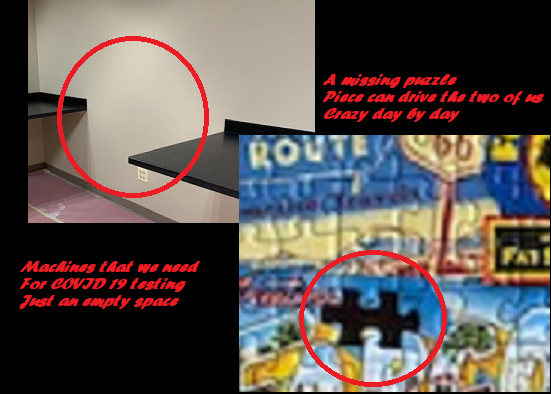
Miss #1:  We Could Be Testing, Yeah!

Our laboratory is still open, and we came so close to being able to do some COVID testing. As I wrote last year, we planned on entering the field of molecular microbiology (MM), a relatively new technique to identify small amounts of bacteria in a patient sample. Instead of trying to grow bacteria in a petri dish as we do in traditional laboratory cultures, and then using a variety of observational and biochemical techniques to identify which bacteria are present, MM actually identifies the DNA present in a sample and compares it to a “hit list” of known bacteria. This technique is quicker and more sensitive than the current technique but not cheaper–2 out of 3 ain’t bad.

And guess what! MM can identify viruses too. In fact, the equipment we need to bring in for our new MM lab protocol is just the equipment that is used in COVID testing. If only we had obtained it a few months ago!

Sadly, the building process (new lease, budgeting, bidding, waiting for the former tenant to leave the space) took longer than expected, as it always does. Our build-out was completed today (hurray) but the testing instruments and training to use them are no longer available. I trust they are being used wisely at some other laboratory doing COVID testing, but we would have liked to have been able to provide this test for our patients who met testing criteria.

Miss #2: It’s a Puzzlement

After our flopped attempt at a YouTube masterpiece, Barb and I turned our attention to the 1000 piece jigsaw puzzle we had ordered to help fill stay-at-home days. It was a difficult puzzle, composed of pictures of classic postcards from around the country–you know, the “Greetings from Sunny California” type. Neither of us is a puzzle veteran, so we attacked the challenge systematically, first the outer frame, then the larger, most obvious colors and shapes. The finely detailed areas came last.

After 4 days and nights of squinting, comparing, and pressing things into place, we had a 99.9%  completed puzzle. Alas, the 1000th piece in the box was a duplicate of piece 999 and we were left with a giant hole in Fargo, North Dakota. Aside from Frances McDormand, I have never given much thought to  Fargo, North Dakota–but when this COVID thing is over, I want to go there and look for my missing piece.

The Haiku Hit

Earlier this month I posted a number of Haiku I had written about our COVID world, and the world seems to have appreciated them. The Haiku have been read in almost 40 countries, including Japan. I’d like to share some of the verses readers have sent in response.

From Dr. Andy Curtis in Canada:

Played God today
No respirator for you
So, so, so sorry

From Juli Krista

Coronavirus
Resets our priorities
Do we have TP?

From Margaret Densley

Cleaning my house now
antibacterial smells
Covid-19 Life

From Woof

Spikey, tiny balls bounce
Collide with humanity…
Obituaries

Thanks and keep them coming!


The opinions expressed above are those of the author and not UroPartners, LLC.


Like what you read here? Add your name to our subscription list below. No spam, I promise!
___

#mc_embed_signup{background:#fff; clear:left; font:14px Helvetica,Arial,sans-serif; }
/* Add your own MailChimp form style overrides in your site stylesheet or in this style block.
We recommend moving this block and the preceding CSS link to the HEAD of your HTML file. */

Subscribe to our mailing list

* indicates required
Email Address *

First Name
Last Name

//s3.amazonaws.com/downloads.mailchimp.com/js/mc-validate.js(function($) {window.fnames = new Array(); window.ftypes = new Array();fnames[0]=’EMAIL’;ftypes[0]=’email’;fnames[1]=’FNAME’;ftypes[1]=’text’;fnames[2]=’LNAME’;ftypes[2]=’text’;}(jQuery));var $mcj = jQuery.noConflict(true);

———————————–

The Lab Rolls, Just Like The Rolling Stones

lab-historyxWant to see what our lab looks like? That’s it on the left. “What?” you say. Where are the pictures of the equipment and the smiling faces and the heads peering down microscopes? Sure, those are all interesting ways of showing the lab. But I was looking for something new.

Inspired by the timeline charts that Wikipedia uses to show the comings and goings of the various members of my favorite rock bands (did you know there have been 14 members of the Rolling Stones?) I decided to create a timeline for our laboratory, from its beginnings in 2005 to the dawn of the new decade.

The chart has one row for each employee, contractor, or consultant–a grand total of 67 people. One column for every year–21 of them now. Different colors for the different areas of the lab: pathologists in blue, histology in red, administrative in green, etc.

Each piece, each element, means something to me. I can compare the three colors when we started to the eight colors now, and see the natural evolution of the laboratory. New disciplines such as hematology and cytology have been added-and I will be searching for a new color when we add a molecular microbiology section later this year.

All those names in the left-hand column! I know they are too small to read in this blog, but when I look at a full-size version of the timeline (we keep one in the breakroom) I can read every name and I remember (almost) every person. There are two of us from the first days, the days when there was no lab but only a dream of one, who are still around. I have been saying “good morning” to a few others for almost as long. Two or three of our techs have come, gone, and returned–there are gaps in their personal timeline.  Those are people who discovered there was no lab like their UroPartners home.

In all, we list 46 people who have left the lab for good. Many used the lab as a stepping stone to their career goals; doctors and nurses and pharmacists and super-coders. Some became supervisors in other laboratories. We are proud of them all.

Although it is true that a few staff members have left under less than optimal circumstances, that is a rarity. I have been happy to write letters of recommendation for the vast majority of our “leavers.” Sadly, we lost two of our valued employees to death–and I think of each of them almost every day when I walk down our corridors checking each department.

We do have a picture wall in the lab decorated with group shots from our annual Lab Week celebration. Most people consider those photos the best way to mark the passing years. But my left-side dominant brain likes the timeline chart. After all, if it works for The Stones it works for me. Who says I can’t get no satisfaction?

Happy New Year to all!


The above is the opinion of the author and not UroPartners LLC.


Like what you read here? Add your name to our subscription list below. No spam, I promise!
___

#mc_embed_signup{background:#fff; clear:left; font:14px Helvetica,Arial,sans-serif; }
/* Add your own MailChimp form style overrides in your site stylesheet or in this style block.
We recommend moving this block and the preceding CSS link to the HEAD of your HTML file. */

Subscribe to our mailing list

* indicates required
Email Address *

First Name
Last Name

//s3.amazonaws.com/downloads.mailchimp.com/js/mc-validate.js(function($) {window.fnames = new Array(); window.ftypes = new Array();fnames[0]=’EMAIL’;ftypes[0]=’email’;fnames[1]=’FNAME’;ftypes[1]=’text’;fnames[2]=’LNAME’;ftypes[2]=’text’;}(jQuery));var $mcj = jQuery.noConflict(true);

———————————–

Quantum Microbiology–Things Get Interesting When They Get Small

pcrEverything is getting smaller. Google has announced that it has created a quantum computer, the Holy Grail of techies. While the computer itself is a massive energy suck, the computational power is lodged in subatomic particles. I don’t understand the science, but I know those subatomic particles must be pretty, pretty, pretty small.

In the lab, we are shrinking things down too. Acting on the theory that nothing stays the same, here at UroPartners Laboratory we are embarking on a fantastic journey into the miniature world of DNA analysis.  We will be adopting a technique known as polymerase chain reaction (PCR) to help us solve the riddle of chronic urinary tract infections.

Why are we doing this? Urinary tract infections (UTIs) cause irritating symptoms and can lead to very significant complications such as sepsis (bloodstream infection,) with lots of Emergency Room visits and hospitalizations. Serious, painful, and costly. We have traditionally made the diagnosis of UTI by bacterial culture; taking a urine sample, spreading it out on a Petri dish covered with agar, sticking the plate in an incubator, and checking the next morning to see if anything has grown. Then comes the process of identifying the growth (disease-causing bacteria? yeast? contamination?) and checking what antibiotics can stop the growth.

It can be a two to three-day process, and it is not perfect. Some bugs don’t want to grow on our little Petri dishes or they may take too long to show up. We do our best, but we know there are many patients who are left without an answer and suffer long-term disease or unsettling complications.

So we are turning to PCR. Our lab will soon be able to examine a urine specimen and in a few hours identify the DNA signatures of the various bugs present. We will also identify the genes that cause the bugs to be resistant to various antibiotics. Better information in a shorter time. A definite win-win.

Like all new technology, PCR for microbiology isn’t cheap. But studies have shown the overall cost to the healthcare system is lowered by eliminating all those ER visits and hospital admissions. And we don’t plan to use the test in all cases, just the problematic ones.

We have to do some construction to create a “clean space” where the DNA in each specimen can be kept isolated from other specimens, so it will be a few months before we get started. But it’s always exciting to start something new. And a hoot for this old dog to learn a few new tricks.


The opinions above are those of the author and not of UroPartners LLC.


Like what you read here? Add your name to our subscription list below. No spam, I promise!
___

#mc_embed_signup{background:#fff; clear:left; font:14px Helvetica,Arial,sans-serif; }
/* Add your own MailChimp form style overrides in your site stylesheet or in this style block.
We recommend moving this block and the preceding CSS link to the HEAD of your HTML file. */

Subscribe to our mailing list

* indicates required
Email Address *

First Name
Last Name

//s3.amazonaws.com/downloads.mailchimp.com/js/mc-validate.js(function($) {window.fnames = new Array(); window.ftypes = new Array();fnames[0]=’EMAIL’;ftypes[0]=’email’;fnames[1]=’FNAME’;ftypes[1]=’text’;fnames[2]=’LNAME’;ftypes[2]=’text’;}(jQuery));var $mcj = jQuery.noConflict(true);

———————————–

Our Lab Professionals Trump Our Lab Processors

processor
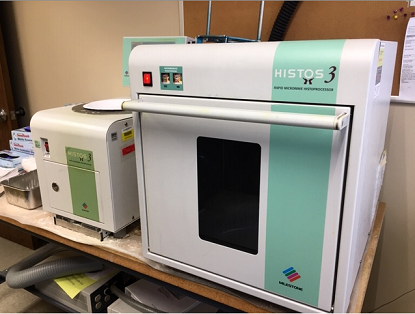
Our microwave processor with a blown heating element.

Our histology microwave unit gave out yesterday. Oversimplifying a bit, the instrument removes processing chemicals from our tissue biopsies and replaces it with paraffin wax. This wax infiltrated tissue is then thinly cut by our histology technologists, placed on glass slides, stained, and then turned over to the pathologists to make a diagnosis. So when the processor goes, it puts a crimp, or more realistically a crash, in our operations.

We pamper our instruments, give them routine maintenance, and have the service companies on speed dial. But even so, sometimes parts fail. In this case, it was a heating element in the microwave unit of the processor. We were dismayed to learn it would be a two-day wait to get the service technician and the new part on site.  We needed Plan B.

We have contacts at several area hospitals and private labs who have agreed to let us come by and use their equipment when we are in a jam. But some of those labs were having instrument problems of their own and other labs were facing the post-holiday rush and could only give us a short window of time to do our processing. It wouldn’t be enough.

Putting their heads together the histology team theorized a potential, but slow, workaround using a different piece of equipment to boil out the chemicals and infiltrate in the paraffin. I authorized a trial with some sample tissue and we waited to see if the process would work.

The test worked fine, and we decided to could process our patient samples using the workaround. But it would be time consuming and we could see from our electronic ordering system that today we would be receiving an exceptionally heavy load of biopsies.

I was reviewing our staffing options to handle all the biopsies with the section supervisor. Overtime work, weekend hours, and on-call staffers were all options that we considered. And then one of our techs walked over and said in a very matter of fact voice “Don’t worry Dr. Raff, we’re professionals. We’ll get it done.”

Hell yeah! I sometimes forget just how good and tight and willing to do what it takes this lab team is. Not just in histology, but also in cytology and chemistry and microbiology and hematology. The behind the scenes staff, too. I cannot think of a single time they have dropped the ball. In 13 years, neither rain nor snow nor dark of night has ever prevented one of our patients from getting their lab results and diagnoses in a timely manner.

Our accrediting agencies say we are a good lab because we meet a few thousand line items on a checklist. I know that we are a good lab because that is what our staff wants it to be, and they strive for it every day. So I am not going to wait for National Laboratory Week in May to say thank you to this team we have built, to the professionals who never stop making me proud.

Thank you, and Happy Holidays. You never let us down.


The opinions expressed are those of the author and not necessarily those of UroPartners LLC.


Yesterday’s blog’s best comment: Helen Peters: Dizzy and Kung Fu Fighting??? Really?? But no Beach Boys, no Eric Clapton, no Tom Petty, no Cars? Even Brittany Spears would be better than Dizzy or Kung Fu Fighting!!!  

____
Like what you read here? Add your name to our subscription list below. No spam, I promise!
___


#mc_embed_signup{background:#fff; clear:left; font:14px Helvetica,Arial,sans-serif; }
/* Add your own MailChimp form style overrides in your site stylesheet or in this style block.
We recommend moving this block and the preceding CSS link to the HEAD of your HTML file. */
Subscribe to our mailing list

* indicates required
Email Address *

First Name
Last Name


//s3.amazonaws.com/downloads.mailchimp.com/js/mc-validate.js(function($) {window.fnames = new Array(); window.ftypes = new Array();fnames[0]=’EMAIL’;ftypes[0]=’email’;fnames[1]=’FNAME’;ftypes[1]=’text’;fnames[2]=’LNAME’;ftypes[2]=’text’;}(jQuery));var $mcj = jQuery.noConflict(true);